

Written by Jan Lai, EAYW Advisory Board member
Edited by Lorena Baric, EAYW rapporteur
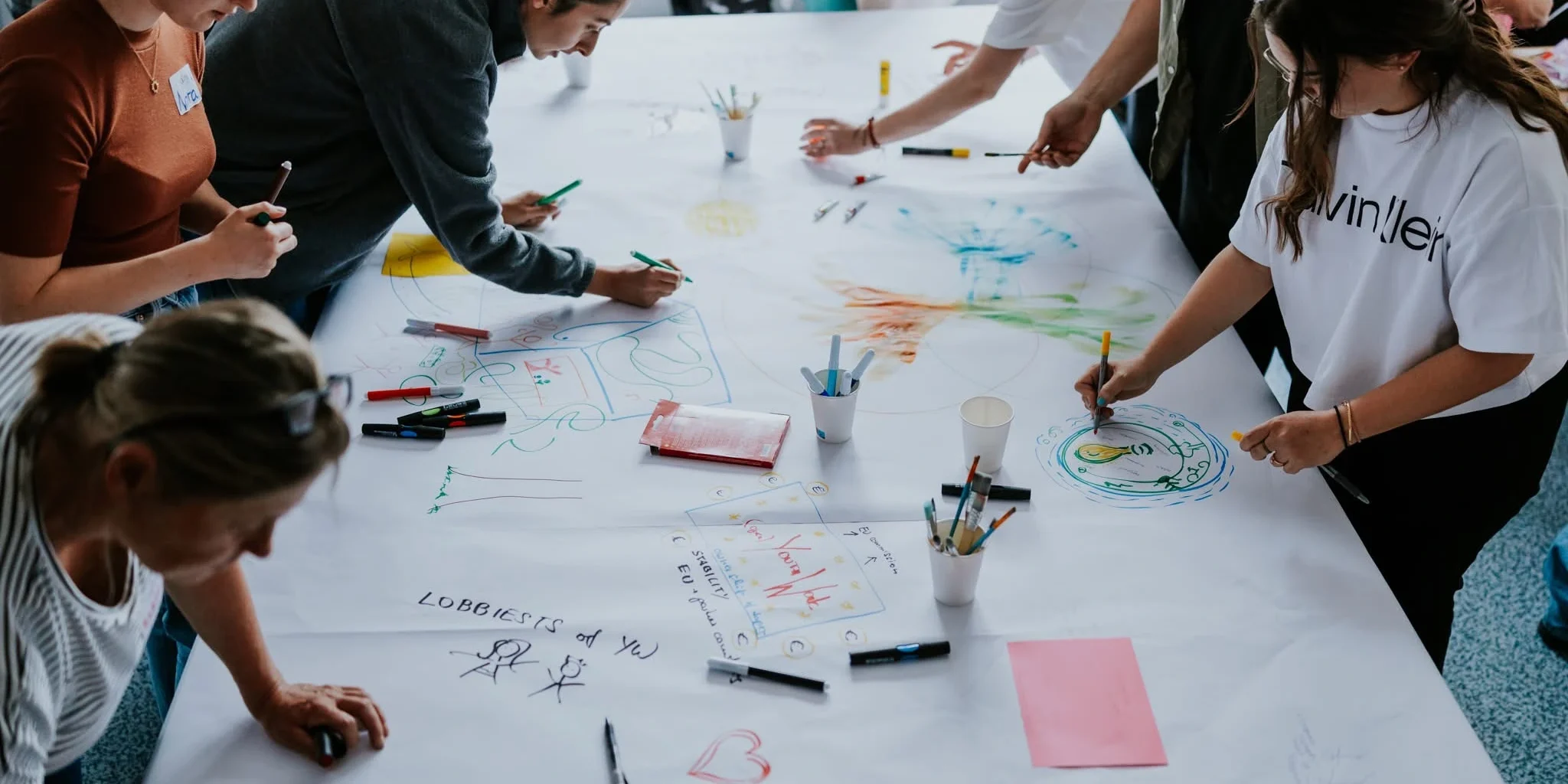
Held at the 4th European Academy on Youth Work in Kranjska Gora, Slovenia (5–8 May 2026), this Deep Dive tackled a question every youth worker recognises: how do you engage young people whose lives happen on TikTok and in the town square at the same time? Facilitated by Anna Yeghoyan and Gabi Steinprinz, the three sessions combined an unusual physical exercise, a tested programme model from Poland, and practice stories from Palestine, Belgium and the Netherlands — each one a different way of building the bridge between scrolling and talking.
A square drawn on the floor
The session began with a strange instruction. On the floor, a square marked out in tape: this square is the internet. Step into it. No talking. No touching. No role-playing. Just your body, moving through an imaginary digital space – doing whatever you feel like doing there. Then step out, and do the same in an imaginary public square.
Sounds strange? It was – and that was exactly the point. Before analysing young people’s online lives, the youth workers, trainers and policy practitioners in the room were asked to feel them. What they noticed was immediately familiar: some retreated to the edges and watched; extroverts pulled others in; the fear of missing out crept up; almost everyone went looking for a corner that felt safe. “My phone is my safety space even in public spaces,” admitted Nora, an educator from Ireland — and the room recognised itself in the line. One humbling realisation surfaced too: however hard adults try, they can’t fully step into a young person’s shoes.
Why it matters now
Young people today don’t live online or offline. They live in both at the same time. Yet much of the conversation in youth work still frames screens as problems to be managed rather than spaces to be understood. This Deep Dive pushed further: not towards banning or endorsing, but towards imagining a meaningful hybrid future where digital and physical participation reinforce each other. And towards acknowledging the diversity of experiences young people live across the two settings – where the same person can be highly active and visible in one space and quietly withdrawn in the other, or the reverse. In a field where change and uncertainty rule, that reframing matters: it calls on youth workers to understand and shape these hybrid realities proactively, rather than passively adapt to them.
The reflections in the room surfaced some productive disagreement. Is the digital space less intimidating because there is less fear of being judged – or harsher, because online judgement can be relentless and every small act carries consequences? Does being active online predict being active offline? On both questions, the room split. One conclusion, though, was shared: not all young people want the same things, and forcing them into activities doesn’t work.
What participants explored
 The most developed answer to “so what do we actually do?” came from Poland. Agata Wiatr presented the Academy of Local Animators, a programme now in its twelfth edition, which takes young people from first contact to running their own civic initiative in five concrete steps: online recruitment and promotion; a team-building trip; workshops with experts; preparation with a mentor’s support; and a final initiative the young people run themselves. Notice the sequence – it starts online, where young people are, and ends in the real world, where their ideas land.
Twelve editions have produced usable lessons. Mix experienced and inexperienced participants — the newcomers often bring the freshest ideas. Treat the group’s diversity and network as an outcome in itself: “I’m not alone” counts as a learning result. And practise the hardest skill of all: letting go, so the initiative genuinely belongs to the young people — while staying present as the supportive figure they still need. In Poland, where youth work is not formally recognised, youth workers are called “animators”, and participants described what animators are for them in images worth keeping: chocolate (everyone needs them sometimes), an extension cord (connected to everyone), a jellybean (flexible enough to stretch).
Three short practice inputs then showed the TikTok-to-real-talk bridge being built from three different directions.
Walaa Kilani joined the room online from the West Bank, Palestine (the session itself was hybrid) and reframed the whole problem in one move: the challenge is not only that young people have a voice, it is creating the conditions where that voice can be heard, in presence and online. Her order of operations is concrete: build safe spaces first; then help young people meet others and break out of their bubble, so participation doesn’t stop at the screen. In Palestine, where democracy and human rights are everyday necessities rather than abstract debates, youth participation runs strikingly high. “Listening is as important as speaking,” she reminded the group.
Marike Aerts, from Belgium, works the bridge in one direction: real talk about TikTok. Her organisation runs offline, gamified workshops about online life – cyberbullying, AI, and its positive sides too, like online-identity workshops built around a photo lab, where young people examine how they present themselves on screen while sitting in a room together.
 Selina, from the Netherlands, works in the other direction: TikTok to reach real talk. She is a content creator herself, and her online street interviews ask young people a direct question – what change do you want to see in your life offline? Being known from her videos breaks the ice; many young people who won’t appear on camera still hang around while she films, and the deeper conversations happen afterwards, offline. Her method, in her own words, builds “a bridge between the offline and online worlds.”
Against these working examples, the session named the obstacle honestly: the expectations placed on youth workers are enormous. Be a role model. Lower barriers. Offer international opportunities. Reach out to those who never show up. And do it all with limited time, limited recognition, and limited institutional support. “Youth workers shouldn’t be a jack of all trades,” Karin, a youth worker, countered — naming the limit the youth field keeps running into.
Looking ahead
A closing team-building quest made the session’s final point physically: a community circle is not a space you set up but a process you go through – in this case one of collaboration, awareness of context, curiosity about differences, and sharing. That, the group concluded, is what a meaningful hybrid future requires: less about tools, more about posture. Be a consistent, non-judgmental presence that reaches out, shares ownership and stays patient. “Let young people gather other young people,” suggested Zeno, a student from Belgium. Some participants went further – “we have to be brave about our role as youth workers,” one participant offered, and another argued youth workers should accept being activists in some form – while also fighting for their own recognition, resisting frameworks that reduce their work to measurable outputs, and refusing to do it all alone.
 The open question left on the table: how do we empower young people to advocate for themselves, while still being the ones who create the conditions that make it possible? It’s a tension worth sitting with – perhaps in a square drawn on the floor.
A final round asked participants to share what they are taking home, creatively in the form of a haiku, and one stayed longer than a TikTok reel:
Come find me online
Where I can speak my own truth
It is where I hide
(Marike, youth worker, Netherlands)
Key messages from the Deep Dive
The following key messages capture the main insights from the Deep Dive and offer starting points for further reflection.
Meet young people where they scroll – then walk with them into real talk. Use online formats (videos, interviews, recruitment) to open the conversation, and deliberately move the deeper part offline, as Selina’s street interviews do.
Talk about online life, offline. Gamified workshops on cyberbullying, AI or digital identity — like Marike’s photo-lab sessions — turn the screen into something young people can examine together, rather than a habit adults lecture about.
Don’t read online behaviour as the whole person. The loudest voice in the group chat may be the quietest in the room, and vice versa. Design activities with more than one way in — and never force participation.
Safe spaces come first; helping young people break out of their bubble comes second. A voice only matters where it can be heard — and listening is as important as speaking.
Hand real ownership to young people, let them gather other young people, and structure your programme — like the Academy of Local Animators’ five steps — so it ends with them leading, not you.
Set boundaries on the jack-of-all-trades expectation, build networks with other youth workers, and lobby for the recognition and resources the work actually needs.
Want to find out more about this topic?
If you would like to find out more about the topic, you can find additional materials from the Deep Dive down below. The resources bring together research, reflections and practical tools related to social media, digital youth work, democracy and the changing realities of young people’s lives.
They are intended to support further reflection and offer starting points for anyone interested in continuing the conversation beyond the Deep Dive.