

Written by Cristina Carniel, EAYW Advisory Board member
Edited by Lorena Baric, EAYW rapporteur
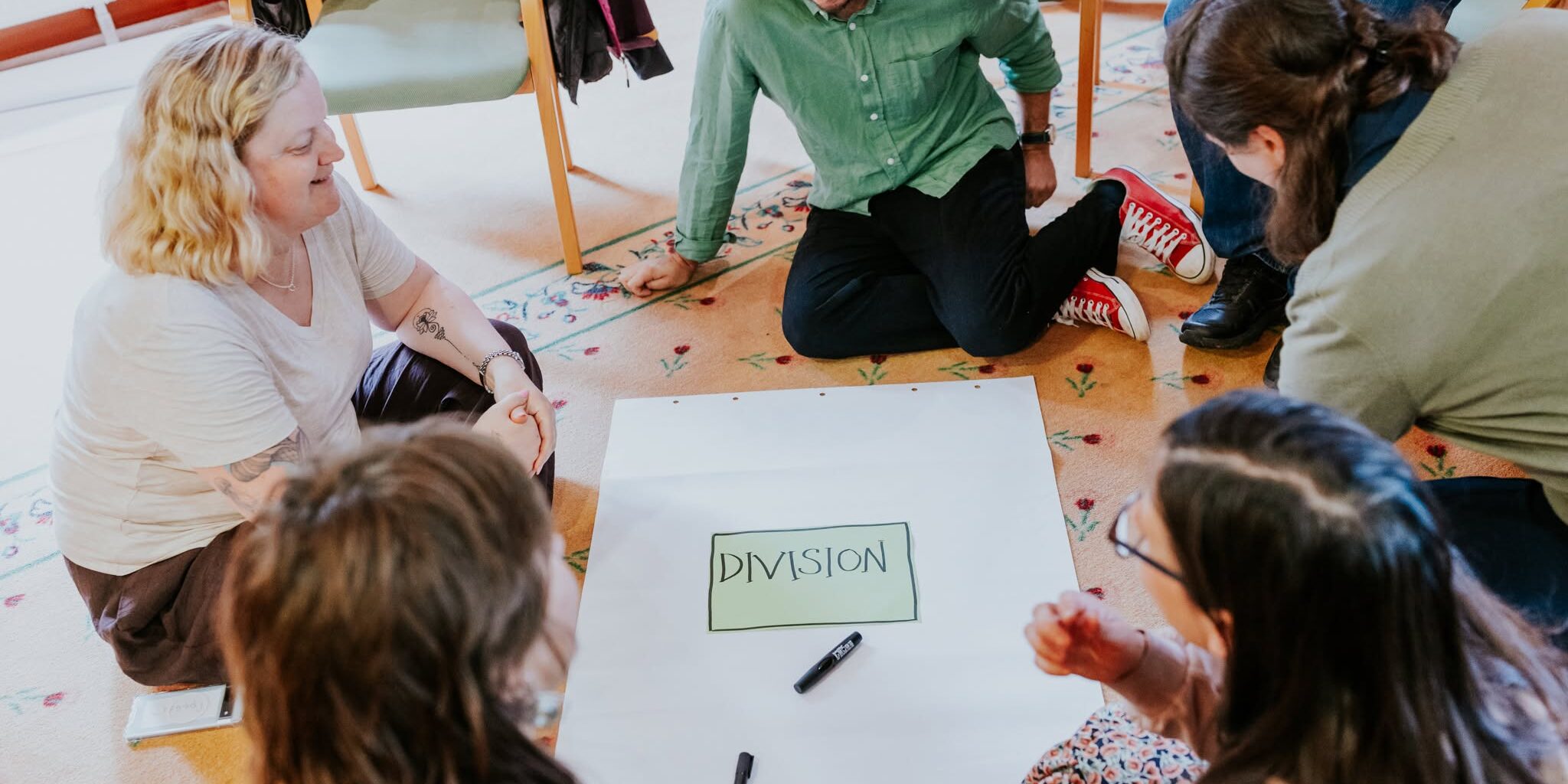
From Division to Dialogue: supporting young people in times of conflict was the focus of a Deep Dive session at the 4th European Academy on Youth Work. Youth workers heard that conflict is increasingly shaping young people’s lives, and that youth work is being asked to respond more directly, more politically and with more care for dialogue and trust.
The elephant in the room
“The political dimension is the elephant in the room. I’m really angry that we’re not doing anything.”
The words came from a participant from the UK. And this statement pointed to something the whole session is about: in times of conflict, staying silent is itself a choice and can become a position itself.
Why it matters now
The scale of the problem is hard to overstate. Over 473 million children now live in areas affected by conflict. More than one in five young people worldwide are growing up in the middle of one. But numbers like these can flatten what is actually a deeply uneven picture. A youth worker in Tbilisi navigating political repression is doing a different job than a youth worker in Amsterdam running a dialogue programme about polarisation. The group kept coming back to this, saying: we cannot talk about “young people and conflict” in a homogenous way, as if it is one story. Economic conditions, culture, history and migration backgrounds shape vastly different experiences, and the kind of support that makes sense in one context may be irrelevant or even harmful in another.
What connects these different realities is a shared question: what role can youth work play?
What we explored
Facilitated by Ekaterina Sherer and Vojislava Tomic Radivojsa, the Deep Dive session tried to answer that question from multiple directions.
 The first direction was relational. Participants argued that young people still carry enormous potential for peace but that this potential needs somewhere to land. Safe spaces matter, not as places where conflict is kept out, but as places where young people can connect, speak freely, experiment with who they want to be, and, as El, a participant from Belgium, put it: simply have fun. “Sometimes we forget the feeling and importance of fun in our work,” she said. It was a reminder that youth work in times of conflict does not have to be heavy all the time to be meaningful.
The second direction was political. A persistent tension ran through the sessions: how do youth workers facilitate dialogue while remaining open, non-judgmental and aware of their own biases? And is facilitation enough or does the current moment demand that youth workers take a clearer position?
Salome Adamia, a youth worker from Georgia, brought the global picture into the room with data on conflict-affected youth and her own experience of working in a country where civic space is shrinking fast. She shared an example where dialogue was facilitated between Palestinian and Israeli delegations at a winter school by making conflict visible, and not by avoiding it. The pedagogical approach was to focus on the participants rather than the conflict itself and to ensure the facilitation team had done their own inner work first, including being honest about their own positions.
A recurring call in the Deep Dive was to bring back intercultural, civic and peace education as core parts of the youth work curriculum – not as add-ons or special projects, but as a foundational practice that every youth worker needs.
Looking ahead
The Deep Dive did not end with ready-made solutions. What it did produce was a sharper set of questions. Youth work is often fragile, trying to make a difference while fighting for recognition, funding, and the vocation’s basic survival. Several participants showed this by sharing situations where organisations are blacklisted or defunded the moment they support young people’s right to protest.
 Despite this precarity, the group’s direction was clear – youth work needs to become more courageous, more independent and more willing to engage with conflict rather than look away. “Be radical, be critical, challenge the systems,” said Markus, a participant from Germany: “We should stop remaining silent. We should dive deeper into the difficult situations happening in the world. This should not only be done by independent teams and groups, but also by more powerful entities.”
The open question the group left on the table: how to create spaces where different emotions and perspectives can be expressed safely without deepening the very divisions we are trying to bridge. This is one that none of the three sessions fully resolved. But perhaps that is the point. As El reminded the room: youth work does not have to have all the answers. It has to have the courage to stay in the conversation.
Key messages from the Deep Dive
The following key messages capture the main insights from the Deep Dive and offer starting points for further reflection.
More than one in five young people worldwide are growing up in conflict, so youth work cannot treat it as something happening elsewhere.
Contexts differ enormously, and what helps in one place may be irrelevant or harmful in another.
In times of conflict, choosing not to engage is still a choice.
They are places where young people can connect, speak freely, be themselves, and have fun.
Youth workers need to be honest about their own biases and positions before holding space for others.
Peace, civic and intercultural education should be core youth work practice, not add-ons or occasional projects.
Being critical and independent matters, but so does support from more powerful institutions.
Youth work needs the courage to stay in the conversation.
Want to find out more about this topic?
If you would like to find out more about the topic, you can find additional materials from the Deep Dive down below. The resources bring together research, reflections and practical tools related to AI, digital youth work and the changing realities of young people’s lives.
They are intended to support further reflection and offer starting points for anyone interested in continuing the conversation beyond the Deep Dive.