

Written by Alicia Holzschuh, EAYW Steering Group member
Edited by Lorena Baric, EAYW rapporteur
Held at the 4th European Academy on Youth Work in Kranjska Gora, Slovenia (5 – 8 May 2026), this Deep Dive brought together youth workers, trainers and policy practitioners to explore what polarisation and democratic fragility mean for youth work – and for the position youth workers take within it. The three sessions were designed not to provide answers, but to open space for exploration: connecting the dots between fragile democracy, polarisation and the positioning of youth workers, examining megatrends shaping the years ahead, and imagining possible, preferable and potential futures for the field. A practice perspective from Serbia grounded the reflections in a reality where these questions are anything but theoretical.
What happens to youth work when the democratic ground beneath it begins to crack?
“Fuck neutrality!” one participant said throughout the Deep Dive working sessions – a reaction that captured the urgency of the topic with an uncomfortable question: can youth work remain neutral when the values it stands for are increasingly under pressure? Across countries and contexts, participants reflected on what it means to support young people in societies marked by polarisation, distrust, and democratic fragility.
Why it matters now
 Fragile democracy and polarisation are no longer distant risks; for many youth workers across Europe, they define the reality in which they operate. Yet the session quickly revealed that this reality looks profoundly different depending on where you stand. For some participants, democratic erosion and repression are already daily experiences. Others spoke from contexts where democratic institutions still feel relatively stable. Working with Sitra’s megatrend cards, participants examined the emerging trends reshaping the conditions for youth work: the populist use of power and the personalisation of politics, growing ideological and religious divides, democracies wavering while authoritarianism gains ground, and technological shifts changing how young people access knowledge and form their views of the world. As the ability to navigate the information environment becomes more critical and political narratives grow more divisive, the question of youth work’s role becomes increasingly urgent.
What participants explored
At the centre of the discussion was a tension that many participants felt: youth work is not outside the system – it is part of it. But what happens when the same system funding youth work becomes increasingly hostile to its values? Participants reflected critically on the idea of neutrality, questioning whether it has ever truly existed and whether it remains possible in contexts of democratic decline.
“We are lacking the vision of us being the drivers of change! Can we really be neutral in these times of uncertainty?”
one participant asked. There was also a sobering recognition: the field has been discussing the same challenges – funding, recognition, defending democracy – for decades. What is preventing youth work from moving forward?
The discussion challenged the narratives youth work reinforces: do we unintentionally reinforce voices attacking democratic values by constantly reacting to them? Shouldn’t we actively create stronger alternative narratives? And polarisation, participants noted, is not only enforced by algorithms – it is also fed by what we ourselves choose to repeat, comment on and amplify.
The question of positioning kept returning in different forms, perhaps most sharply in one participant’s words: “Am I the movement, or do I facilitate the movement?” The group did not settle on a single answer, but a nuanced picture emerged: the position of a youth worker is not static. It shifts between neutrality and engagement depending on the setting, the needs of young people and the pressures of the moment – and it demands constant critical reflection on the effects of the position we take. As one participant put it:
Nothing is neutral, but if your bias is on the side of human rights, it can’t be wrong.
A view from practice: Serbia
 A powerful practice perspective came from Serbia. Minja Bogavac, theatre director, dramaturge and Creative Director of Center E8 (a leading civil society organisation dedicated to working with and for young people) shared experiences from a society marked by deep polarisation and widespread protest. With thousands of demonstrations, increasing violence against young people, shrinking civic space, and youth organisations facing blacklisting and funding cuts, “regular” youth work has become increasingly difficult. Yet participants also heard a story of hope: young people creating political momentum with the support of the few remaining independent media developing new ways of organising, listening, and resisting. In a scenario where violence is happening against young people, standing inactive and neutral was simply not an option.
This sparked further questions for the group: what role should youth work play in such a political context next to the young people it wants to support – observer, protector, participant, or something else entirely? And when this moment passes, what will be the role of youth work in the next society – rebuilding institutions, defending the interests of young people, or something not yet imagined?
Looking ahead
 When participants turned to the futures they would prefer for youth work in the next seven years, a shared direction emerged despite the different realities in the room. The most frequently named future was one of dialogue and encounter: physical, open spaces where being different is okay but conversation remains possible, where community thinking and solidarity sit at the core, and where youth work functions as a lived “microdemocracy place” – a space where democratic values are practised and defended, not just taught. Alongside it, participants imagined a sustainably funded and recognised youth work environment that enables youth workers to act as agents for young people, and a field that is genuinely inclusive: safe, intersectional and open to all.
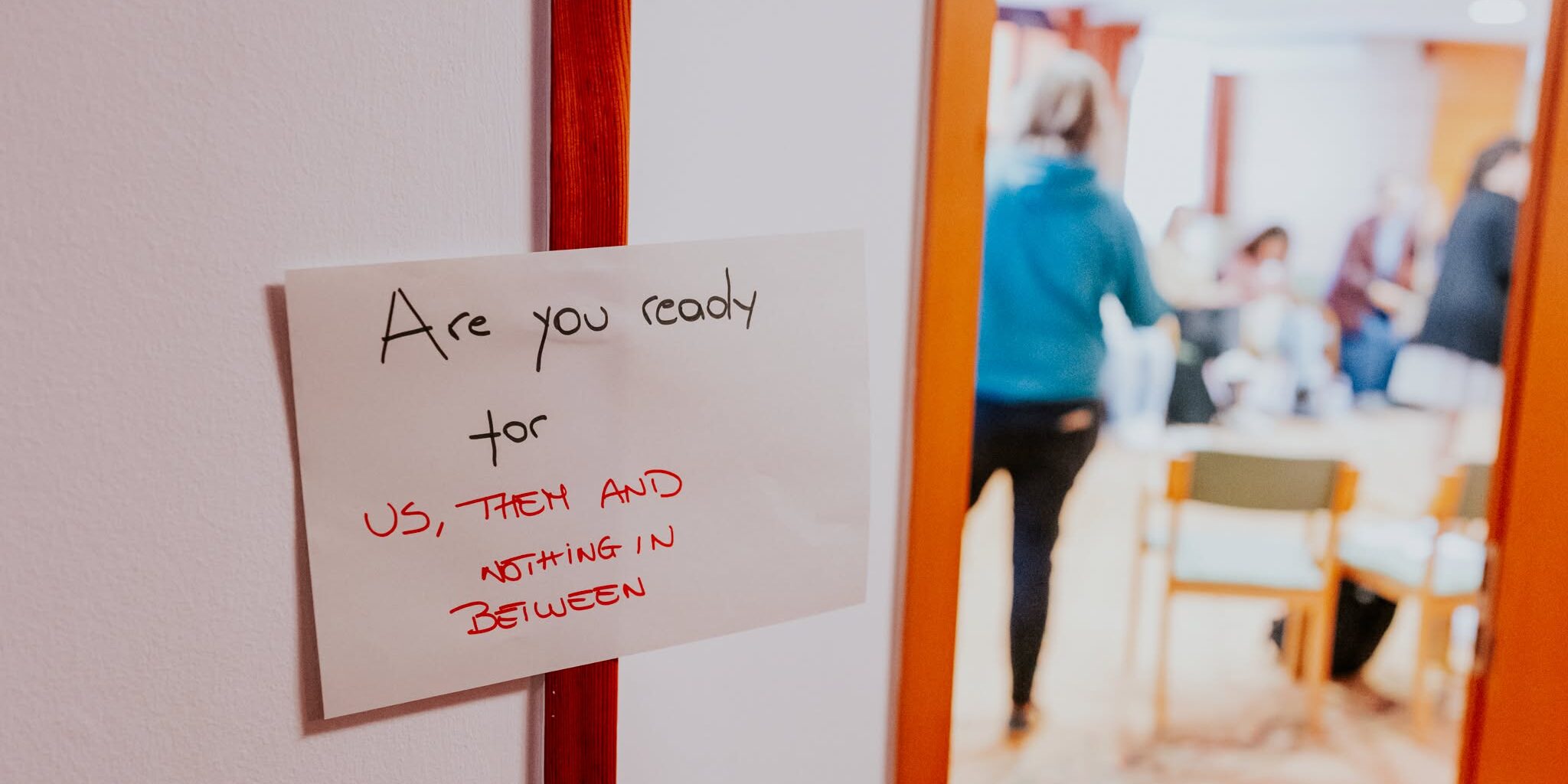
Dialogue emerged as youth work’s most distinctive tool – connecting and listening, supporting the often silent majority in the middle to speak up against the loud extremes, and showing, rather than just describing, the positive alternative to polarisation. If we believe in interdependency, participants reflected, then having “nothing in between” is impossible: youth work must also engage with narratives far from its own if it wants to create real change beyond its bubble.The session closed without definitive answers, but with a stronger awareness of the contradictions shaping the field. Youth work is often fragile itself, trying to create change while fighting for recognition, funding, and survival. If democratic uncertainty becomes the norm, the youth work community may need to move beyond asking whether neutrality is possible and instead ask: what kind of responsibility are we willing to take? And what risks are we prepared to face in shaping the futures we want for young people? As one participant reminded the group: don’t re-act – act pro-actively.
Key messages from the Deep Dive
The following key messages capture the main insights from the Deep Dive and offer starting points for further reflection.
Fragile democracy and polarisation are not future risks but the present operating context of youth work — though that context looks radically different across Europe, from stable institutions to daily repression.
Youth work is part of the system, not outside it. When the system that funds youth work grows hostile to its values, the field faces a structural contradiction it cannot ignore.
Neutrality was challenged from every angle: it may never have truly existed, and in contexts of democratic decline it may not be possible. The youth worker’s position is not static – it shifts between facilitation and engagement depending on the setting and the needs of young people, and it requires constant self-critical reflection.
Narratives matter. Youth work risks amplifying anti-democratic voices by constantly reacting to them; the alternative is to actively build and show stronger narratives of its own.
Dialogue is youth work’s distinctive tool: creating spaces of encounter, supporting the silent majority to speak up, and practising youth work as a “microdemocracy place” where democratic values are lived rather than lectured.
The question the field is left with is no longer “can we be neutral?” but “what responsibility are we willing to take – and what risks are we prepared to face?”
Want to find out more about this topic?
If you would like to find out more about the topic, you can find additional materials from the Deep Dive down below. The resources bring together research, reflections and practical tools related to AI, digital youth work and the changing realities of young people’s lives.
They are intended to support further reflection and offer starting points for anyone interested in continuing the conversation beyond the Deep Dive.