

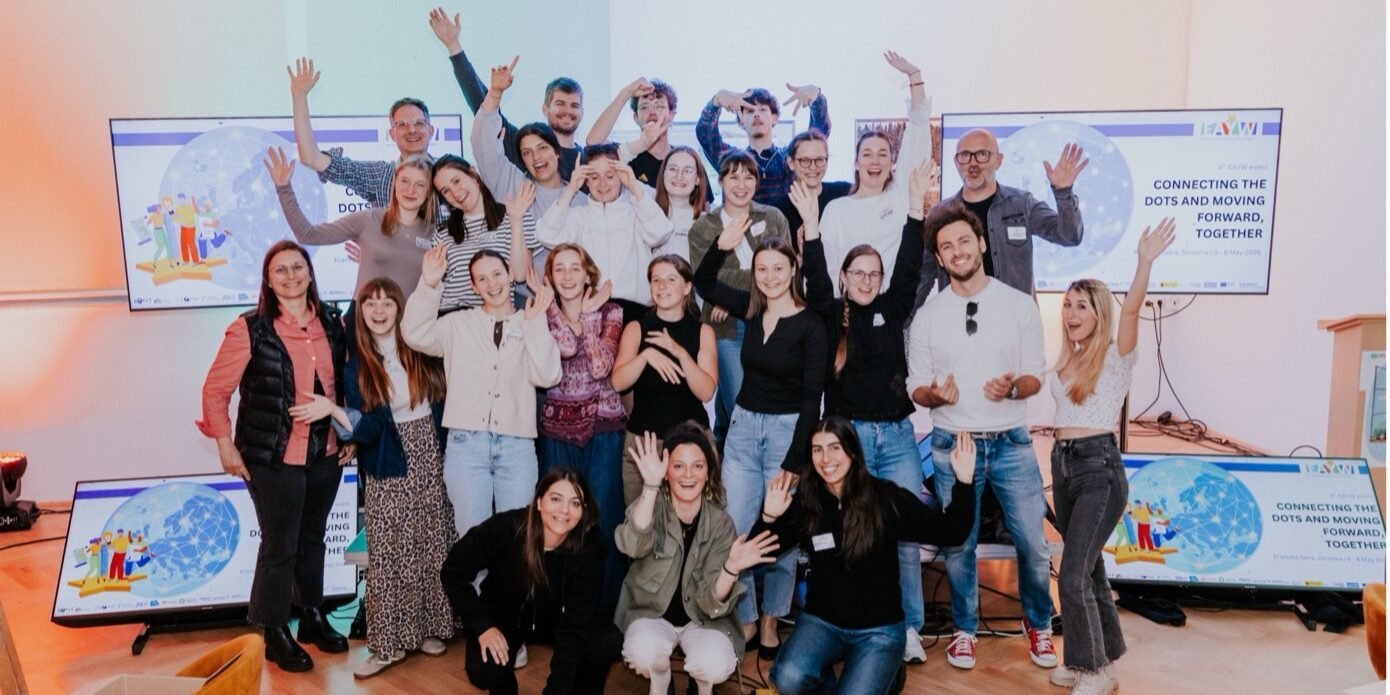
Twenty students of youth work and social work from five countries joined the 4th European Academy on Youth Work to interview practitioners about youth work in uncertain times. Four of them, from IU – International University Dresden, look back on the week. After their reflection, we bring together what the interviews surfaced and where the collaboration goes next.
A week of learning, exchange and inspiration
Nora Dombrowe / Emma Sophie Hunger / Paula Petasch / Nora Steglich
IU – International University, Campus Dresden, Germany
As four Social Work students from Germany, we had the great privilege of taking part in the Students Project with 16 other students from Belgium, Italy, Slovenia and Croatia at the European Academy on Youth Work (EAYW) in Slovenia in May 2026. Before arriving, we were excited but also a little nervous. However, these worries disappeared very quickly. From the very beginning, we felt warmly welcomed by everyone. We were not only accepted as students, but our perspectives, ideas and thoughts were also highly valued. The open and supportive atmosphere encouraged us to share our own experiences, ask questions and actively contribute to the discussions.
 The week was an exciting, inspiring and enriching experience for all of us. It was fascinating to meet people from many different countries and to learn how youth work and social work are organised in their own contexts. Although many countries face similar challenges, we discovered that there are many ways of dealing with them. This international exchange broadened our perspectives and gave us many new ideas for both our studies and our future professional practice.
At the same time, the week was intensive, because we were also running our own student project, in which we interviewed participants of the EAYW. These conversations gave us valuable insights into youth work. One of the strongest messages we took away was the importance of openness, authenticity and lifelong learning. Many participants emphasised that youth workers should never stop developing their knowledge and skills, as society and the challenges young people face are constantly changing. Another important point was that youth work deserves greater visibility and recognition in society and politics. We also learned how important it is for youth workers to take care of their own well-being in order to support others in a sustainable way. The interviews were a very special experience for us, as they gave us the opportunity to get to know participants from a wide range of youth work backgrounds more closely. They were one of the highlights of the EAYW for us.
 Among our other favourite memories are the open discussions in the plenary sessions, where everyone had the opportunity to share their ideas and experiences. We also really enjoyed the project and methods market, where participants presented inspiring projects from their own countries. The evening activities gave us the chance to get to know people on a more personal level, which made the international exchange even more meaningful.
Looking back, we are very grateful to have been part of this experience. We are taking home not only new ideas for our studies and future careers but also greater confidence in ourselves. Most importantly, we learned how valuable international cooperation, openness and the exchange of different perspectives are. We were especially impressed by the passion and commitment of the youth work professionals we met during the EAYW. Their dedication, motivation and belief in the importance of youth work were truly inspiring. We are very happy that we had the opportunity to be part of the EAYW, and we would encourage every student to take part in such an experience if they have the chance.
What the interviews surfaced
Working in six teams, one for each Deep Dive of the Academy, the twenty students interviewed twenty practitioners from eleven countries: nine from NGOs, six from youth work organisations, four from the public sector and one self-employed.
The project was coordinated by academics from five universities: Karsten König, Professor of Social Work (IU Dresden); Geert Boutsen, lecturer and researcher (UCLL, Leuven); Valentina Cuzzocrea, Full Professor of Sociology (University of Cagliari); Tadej Košmerl, Assistant Professor of Andragogy (University of Ljubljana); and Marko Kovačić, Associate Professor (University of Rijeka).
The students asked two questions: what do experts and practitioners think about youth work in times of uncertainty, and what are good ways to prepare students for the futures of youth work?
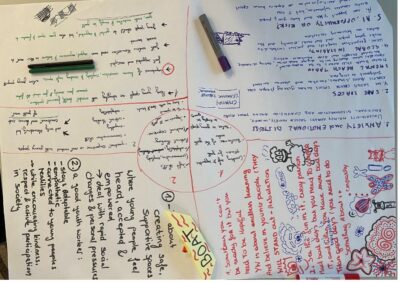
Two answers came up more often than any other: listen, and create safe spaces. At the closing session, the students summed up what they had heard in six messages, each with a line chosen to capture it.
“Uncertainty has always been a reality,” the students concluded. “It creates new opportunities and requires creativity.” Several interviewees questioned the idea that today is uniquely uncertain. A trainer with more than twenty years in non-formal education described how constant transitions had taught people in his country to adapt and find creative solutions. What has changed is the pace: as a municipal youth worker from Belgium put it, while you are still trying to understand one problem, the next one has already appeared.
“Uncertainty is the only constant.”
To act with focus, the students argued, you first have to understand the challenge. And uncertainty looks different depending on where you stand: youth unemployment in Finland, shifting migration rules for young asylum seekers in Slovenia, LGBTIQ+ young people being targeted politically, youth clubs in Norway unsure whether funding will keep their doors open. Mental health and anxiety were the most common thread. A psychotherapist from Spain observed that young people tend either to switch off and act as if nothing is happening, or to feel completely overwhelmed.
“It depends on …”
Outdated resources, ineffective policies and weak advocacy, the students found, make it harder to secure recognition, sustainable funding and better support for young people and youth workers. Funding came up again and again, often alongside frustration that short project cycles cannot capture an impact that only shows over years. The director of a Bulgarian NGO warned against “fast fashion” youth work, meaning projects produced for the grant and dropped when it ends. A policy maker from Flanders named the task directly: to make the impact of youth work clearer “for people who aren’t involved. Or who don’t believe in it.”
“Good youth work cannot survive on passion alone …”
Successful lobbying needs lifelong learning that builds positive thinking, critical reflection, empathy and the ability to understand different perspectives. Empathy and listening were named more than any other quality. The psychotherapist from Spain pointed to the irony that these “soft” skills are among the hardest to develop. Asked how students should learn them, most interviewees answered: through practice, internships long enough to build real relationships, and mentoring. An outreach youth worker from Finland summed up the core skill as being “human to human”.
“Empathy opens perspectives, and perspectives are crucial for progress.”
Why are you doing this? What values inspire you? Are you acting accordingly? These were the students’ questions, and several practitioners asked the same. The president of a youth-led organisation in Slovenia advised students not to hide behind neutrality, but to be open about the political dimension of youth work. A youth worker supporting young migrants described the balance of telling the truth without taking away hope. And from Bulgaria came a reminder of who the work is for: “Leave your ego behind.”
“We need to be a role model without playing a role.”
Youth workers often take on too much pressure and responsibility, the students concluded, so future youth workers need to learn during their studies to look after themselves too, especially in uncertain times. Interviewees stressed the importance of support systems: supervision, colleagues and someone to talk to after hard stories. A programme manager who works with young people’s stories of growing up in war spoke of needing a way to rewind after hard, emotional topics. A youth worker from Slovenia put it most simply: take care of yourself.
“Take good care of yourself – youth work is a marathon, not a sprint.”
“If you do your job well, the best result is that you are not needed anymore“
— Youth worker and NGO director, Bulgaria
Where it goes next
The Students Project is part of a longer story. Students first joined the Academy online during its second edition, held during the pandemic, and have taken part in person at the third and fourth editions.
Building on that experience, Karsten König, Geert Boutsen and Jan Lai, all members of the EAYW Advisory Board, developed a strategic partnership between IU International University (Germany), UC Leuven-Limburg (Belgium), the University of Cagliari – UniCa (Italy) and three youth work organisations: AGJF, NUR and Formaat. The idea took shape in the context of the Academy, where the Advisory Board and Steering Group gave space to think through and discuss the draft.
The project ‘Connecting Universities and European Practice: Shaping the Future of Youth Work’ – CUYouth – runs from September 2026 to August 2029.
Funded by the European Union through Erasmus+, it will develop co-educational modules in which students of youth work and social work learn alongside practitioners, through regional and international seminars and futures-oriented methods such as scenario-building. The teaching materials will be made freely available on the SALTO HOP platform. Where the Academy offers students one intensive week alongside practitioners, CUYouth aims to build that kind of exchange into university teaching over three years.
More about CUYouth: Explore the project website
“We are taking home not only new ideas for our studies and future careers but also greater confidence in ourselves.”
— Nora, Emma, Paula and Nora, IU Dresden
Watch: Karsten König on the Students project, interviewed at the 4th Academy