

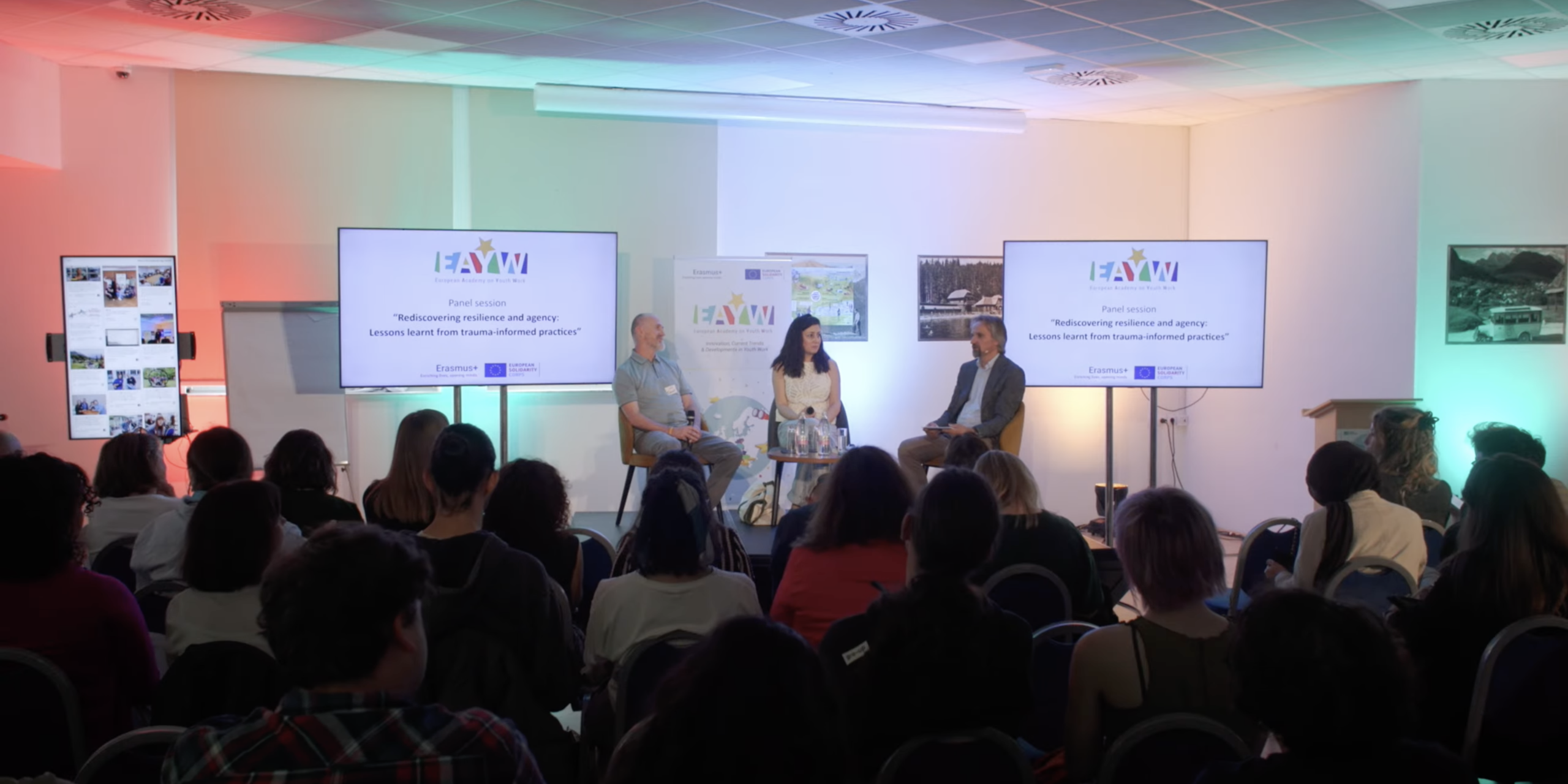
Research from Wales found that for children who have experienced significant adversity such as abuse, neglect, household instability, consistent access to a single trusted adult reduced poor health outcomes from 59.8% to 21.3%. So, not a programme, not a policy but one person who showed up, reliably, regularly, over time. Science caught up with practice, said EAYW co-facilitator Anita Silva as she introduced this panel. Youth workers have been playing that role for decades. The question this session explored was what it actually costs to be that trusted adult.
Hranush Shahnazaryan, a somatic experiencing practitioner from Armenia who came to this work through her own healing, made the case that trauma is not the event but what happens to the nervous system afterwards. Cognitive understanding doesn’t reach there. The body does.
It is impossible to stay present with things if we don’t do our inner work. – Hranush Shahnazaryan
She walked the room through a brief grounding exercise – feet on the floor, back to the chair, eyes turning gently around – to show that a “safe space” is not something a facilitator can declare into existence. It has to be sensed.
Dermot O’Brien, of the National Youth Council of Ireland and a trauma-informed practice trainer, picked up the thread from the practitioner’s side. Young people don’t leave their experiences at the door of the youth centre. They bring them in, and those experiences change three things: their view of themselves, their view of others and their view of the world.
It’s not what we do with them. It’s how we are with them. – Dermot O’Brien
The panel then turned to the question that gave the session its sharpest edge: who takes care of the carers? Resilience, both speakers insisted, is not an individual competence to be stacked on top of an already overwhelming workload. It is collective. It depends on teams that debrief together, organisations that invest in staff wellbeing, and a culture where acknowledging struggle is not seen as failure. As O’Brien put it, drawing on a colleague from the Scottish NHS: “If we neglect the wellness of our people, we cannot expect them to be trauma-informed in their practice.”
The session closed with a guided somatic exercise: feet on the floor, back against the chair, eyes scanning the room, that left the audience noticeably quieter and more grounded than when they had walked in.