What does youth work need to move forward in times of uncertainty? For four days in May 2026, almost 200 stakeholders in European youth work, policy and research tried to answer that question together – and discovered that the better question may be who do we need to be.

The gathering

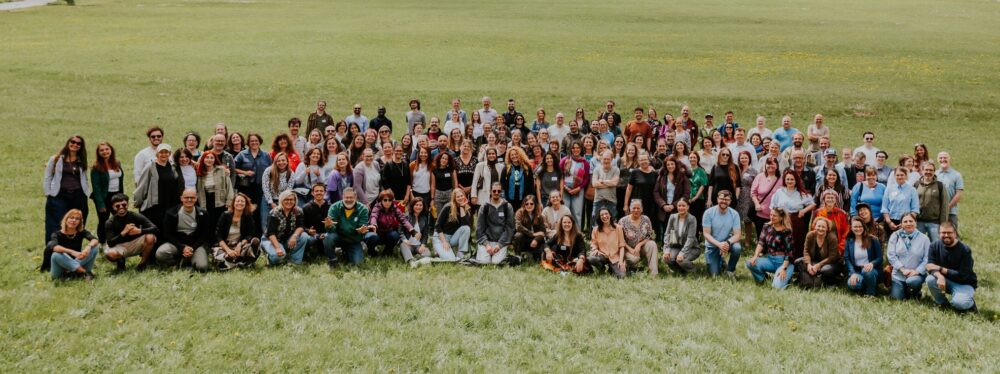
From 5 to 8 May 2026, almost 200 professionals from across European youth work, youth policy and research came together in Kranjska Gora, Slovenia, for the 4th European Academy on Youth Work. The room held practitioners, trainers, researchers, National Agency staff, SALTO Resource Centres, policymakers, students from five universities, and a turtle costume making its now-customary appearance to remind everyone that meaningful innovation often requires us to slow down.

They came to talk about the future. What they ended up talking about, more often than anyone expected, was what it feels like to not know what that future holds, and what that uncertainty demands of the people who work with young people every day.

This was a closing event and a bridging event at once. It marks the end of the Academy cycle under the current generation of EU youth programmes, and opens the question of what comes next. As co-facilitator Darko Marković put it on the final day, we were standing at the edge of an unbuilt bridge.

691796280_1564457175682091_5470318203944785439_n

Uroš Skrinar, Director of MOVIT, opened with a simple call to action: “Let’s go together towards stronger youth work.” From the European Commission Youth Unit, Charalampos (Babis) Papaioannou joined online to remind everyone of the public consultation on the next EU Youth Strategy, a narrow window in which youth work’s place in the future framework will either be argued for or quietly lost.

Before any slides or keynotes, participants were paired up and asked: Why do you do this work? The words that filled the room were passion, impact, freedom, fun, hope, connection, curiosity and these set a tone that held for four days: this work is personal before it is institutional.

A Companion for the journey

The Academy has produced a great deal over the years – reports, research, toolboxes, webinars. The risk in any rich field is that its insights pile up unread. So this edition began with a different kind of deliverable: not another publication, but a Companion.

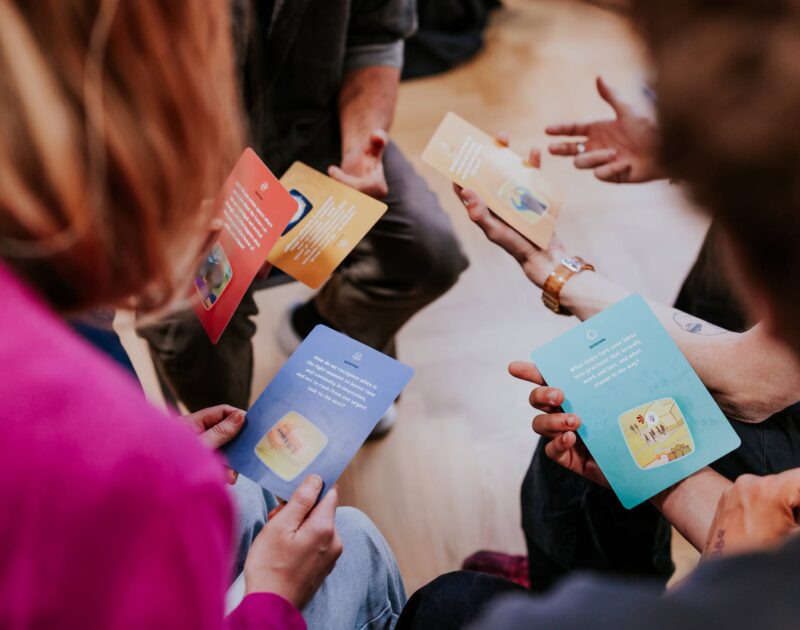
Olga Kyriakidou, who developed it together with Gisèle Evrard and Darko Marković, described the thinking  behind the Companion simply: sometimes you don’t just need another answer. You just need someone or something that can sit next to you and ask difficult questions. The Companion distils everything the Academy has produced since 2019 into a notebook and a deck of cards, i.e. questions designed to challenge assumptions rather than provide closure. As Olga put it: “So you don’t have to navigate change in your youth work alone.”
687681391_1564458135681995_3099387224025125906_n

Three plenaries, one throughline

The programme was anchored by three plenary sessions. Taken together, they formed a single argument arriving from three directions: Peter Merry asked what kind of change we are in; Özgehan Şenyuva asked who we are in relation to each other within that change; and Hranush Shahnazaryan and Dermot O’Brien asked what it costs us personally to show up for it. All three, in different language, arrived at the same place: the systems are too complex for prediction, the relationships too real for politeness, and youth workers cannot sustain any of it if they neglect their own wellbeing.

Rethinking change

Peter Merry, evolutionary leadership thinker, put a name on the feeling many walked in with: hyper-complexity. The interlocking crises our societies face such as climate, conflict, AI, polarisation, are accelerating each other in ways no single field can predict and control. Right now, Merry, argued, we are living through what systems thinkers call a chaos point, i.e., the old system is visibly failing but the new one hasn’t taken shape yet. The good news, he said, is that this is a normal part of change. The harder news is that the conventional “predict and control” tactics don’t work in these moments. What does work is dynamic steering – taking the smallest possible step, gathering data, learning from it, then steering again.

Change-leaders today, he argued, have three roles available: support the emergence of the new, help old systems die gracefully (“hospicing” them so they fertilise the soil instead of toxifying it), and tell the story that lets people choose between the two. The discomfort that comes with being caught between an old system that no longer works and a new one that hasn’t arrived yet is not, he stressed, a sign that something has gone wrong. It is a normal feature of deep change and if we pay attention to it rather than rushing to resolve it, it can tell us what the next step needs to be. But sitting with that discomfort day after day can lead to burnout, and burned-out youth workers are no good to anybody. “Looking after ourselves is not a luxury but a precondition for the work.”

Read the separate article for a closer look at this plenary.

Generations forward

Prof. Dr. Özgehan Şenyuva (Middle East Technical University, Ankara) delivered a friendly but uncompromising provocation: most of what we call “intergenerational” is in fact only pluri-generational – different generations sharing the same space, but without any real exchange between them. Real intergenerational work, he argued, doesn’t happen by accident. It has to be designed, it has to be able to hold disagreement, and it only means something if the people involved can come through conflict and still want to stay in the room together.

His conclusion pushed beyond youth work’s traditional boundaries. As demographic, economic and political pressures intensify, five generations now sharing the same labour market, displacement breaking family lines, digital culture fuelling generational stereotypes, youth work will increasingly need to function as community work, not just youth-specific programming.

Read the separate article for a closer look at this plenary.

Rediscovering resilience and agency

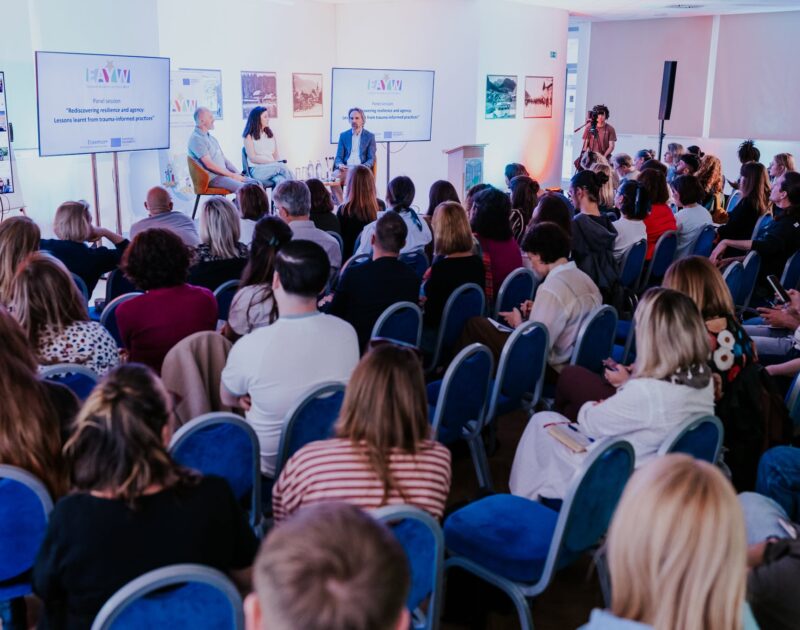
Hranush Shahnazaryan (somatic practitioner, Armenia) and Dermot O’Brien (National Youth Council of Ireland; trauma-informed practice trainer) brought the conversation from systems to bodies. Studies show that the single most protective factor for young people who have experienced adversity is not a programme or a policy, but access to one consistently available trusted adult.

Youth workers often play that role without naming it, and the question this panel explored was what it actually takes to show up that way for others, day after day, without burning out.

Resilience, both argued, is not an individual quality to be stacked on top of an already overwhelming workload. It is collective – it depends on teams that debrief together, organisations that invest in staff wellbeing, and a culture where admitting you’re struggling is not treated as failure. As Dermot put it: “It’s not what we do with young people. It’s how we are with them.”
Read the separate article for a closer look at this plenary.

692799237_1566272082167267_4448254857998219280_n

Six deep dives

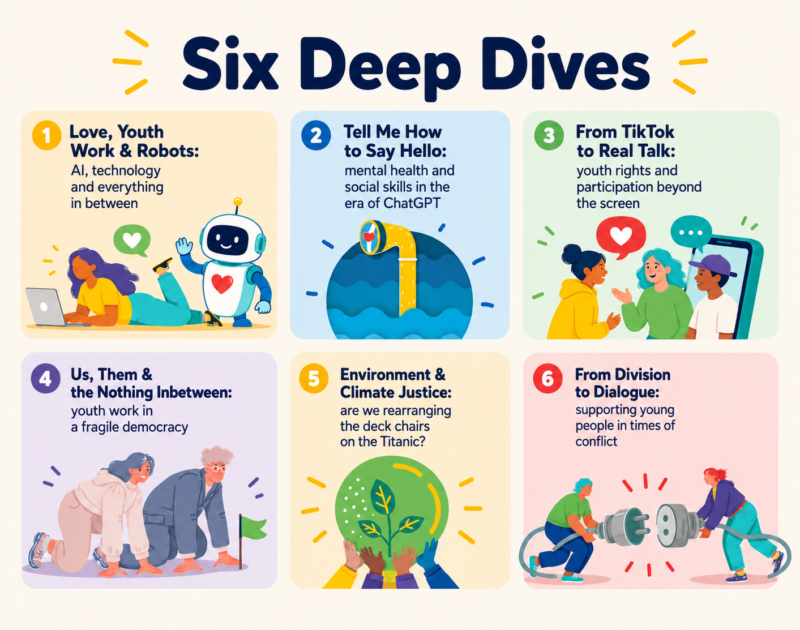
Across three 90-minute sessions, participants stayed with one of these six themes (links to the dedicated articles will be updated soon!):

  1. Love, Youth Work & Robots: AI, technology and everything in between
  2. Tell Me How to Say Hello: mental health and social skills in the era of ChatGPT
  3. From TikTok to Real Talk: youth rights and participation beyond the screen
  4. Us, Them & the Nothing Inbetween: youth work in a fragile democracy
  5. Environment & Climate Justice: are we rearranging the deck chairs on the Titanic?
  6. From Division to Dialogue: supporting young people in times of conflict
Deep_dives_EAYW

A few sparks worth carrying home. From the mental health group: “In developing social skills, we don’t actually need the answers, but connections.” From the AI group, a worry that wouldn’t leave the room: AI can be an extraordinary mental health support (it doesn’t judge, it helps young people rationalise and it also helps them forget). The climate group kept returning to a paraphrased line from Václav Havel: hope is the certainty that something makes sense regardless of outcome. From the democracy group: “Maybe it’s time for youth work to become political again.” And from the conflict group: it is time to bring back intercultural learning and peace education as core parts of the youth work curriculum.

When the six groups reported back, one underlying pattern emerged: every room had circled back to the same tension. As one facilitator put it: “We are practicing youth work in a system that is not aligned with our values. Youth workers are fragile in a fragile system.”

Hope and frustration can exist at the same time, and they should.

– Ilze Jece, Deep Dive facilitator

Making sense together

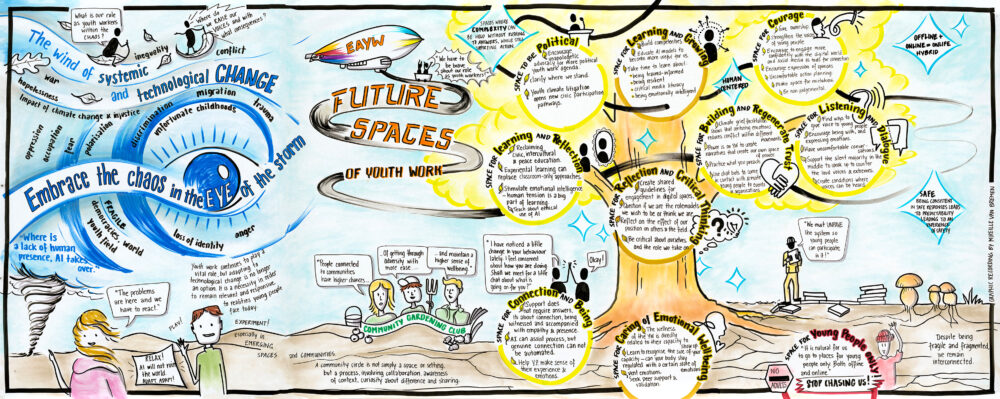
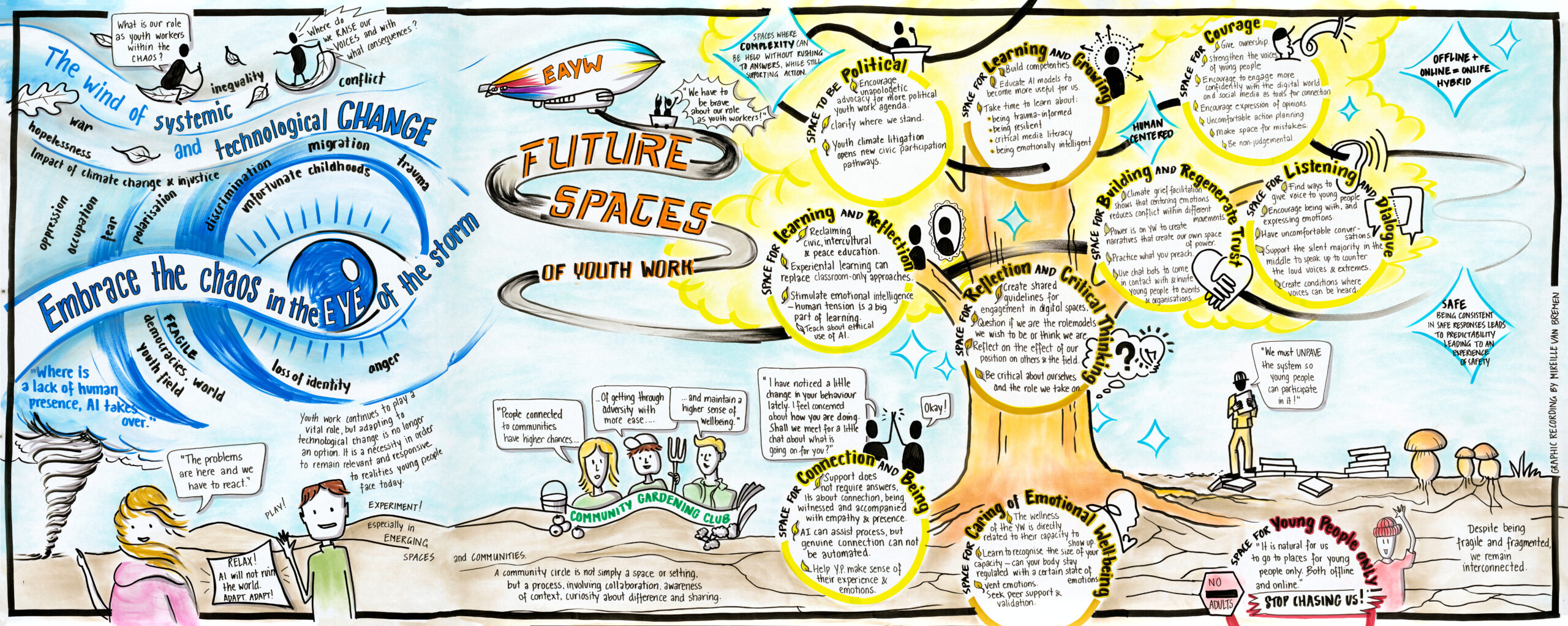
Graphic recorder, Mireille van Bremen, took everything that the Academy had discussed – the plenaries, the deep dives, the corridor conversations – and drew it. She translated two days of conversation into a large-scale drawing that mapped the ideas, tensions and emotional landscape of the Academy and showed desirable future spaces of youth work.

To download a higher resolution of the graphic, find it on the link HERE.
Tools for the road

Beyond the plenaries and Deep Dives, a Tools Labs and a Fair showcased over 60 practices for future-oriented youth work – from futures thinking card games, virtual reality to sustainability checklists and digital youth work frameworks. And the Future Sparks, daily warm-ups mixing playful provocation with hard data, ensured that even the morning coffee fog couldn’t survive first contact with the programme. At the Ljuba & Drago bus parked outside the venue, board games from across the continent gave participants a different way to think about civic participation, conflict and futures.

The next generation looks back

On the final morning, youth work students from five European universities took the stage to present findings from interviews they had conducted with participants throughout the week. “Uncertainty is the only constant,” they observed. Youth work needs more visibility, more sustainable funding, and more honest attention to the mental health of the people doing it. Their closing line stayed with the room and was followed by a standing ovation:


Take good care of yourself. Youth work is a marathon, not a sprint.

Seeds of action

The Academy closed the way it began: with an invitation to participate in something larger than the event itself. Advisory Board members Hilary Tierney and Juha Teubl-Kiviniemi reflected on what the Academy has built.

Hilary spoke about what she called “the better story.” Youth work, she argued, carries an implied promise to young people, and if we want to fulfil that promise, we have to come from the position of hope. Not the passive kind, but an activated hope that brings together curiosity, compassion, creativity, courage and conviction. “We are role models,” she said, “but we are role models in how to be human. How to deal with all the complexity and how to negotiate it together.”

Juha described the Academy as a living organism, one that has kept reinventing itself over four editions, responding to what the field needs. Whether the Academy continues in its current form remains uncertain, but Juha expressed confidence that the instrument and the spirit behind it will endure. He closed with Arthur C. Clarke: “The only way of discovering the limits of what is possible is to venture a little way past them into the impossible.”


Sonja Mitter Škulj, the Academy’s coordinator, asked the room to keep creating spaces to think and talk about the future, whether or not the Academy continues as a project. Each participant committed to one seed of action – experimentation, being political, coaching for collective wellbeing, co-creating spaces with young people, playing and letting go, staying open to what is coming. One participant captured the essence in three words: doing our job.

Resources & follow-up

Kranjska Gora closes one cycle. What grows next depends on what we plant when we get home. As Darko reminded us on the last morning: we don’t sell fruit at the Academy. We collect seeds.

Article written by: Lorena Baric, rapporteur of the EAYW