

Change is everywhere in youth work: Sometimes it is quite visible and it comes through political instability, digital transformation or rising mental health concerns. At other times, change happens more quietly, until it becomes impossible to ignore.
Our last webinar from the “Meet your future – Tools to navigate the future of youth work” series explored how youth work can better understand and respond to change on different levels: on the level of systems and trends, but also on the level of mindset, readiness and action. During the webinar, participants had again the chance to explore two tools from the Futures Toolbox: Fields of Change and How Do I Relate to Future Changes? As in the previous webinars, it was mentioned that the purpose of the tools is not to predict the future, but to support future literacy: the ability to reflect on change, respond to uncertainty and build more future-ready ways of working.
Youth work in a time of pressure and transition, and where do we stand
“How do you usually feel about change?” was the first question participants were asked, and the answers were quite different, which also shows how complex the topic of dealing with change can be. Participants began naming the forces currently shaping youth work: polarisation, shrinking civic spaces, rising mental health issues among adolescents, social media, disengagement, digital devices, declining wellbeing and the growing presence of artificial intelligence.
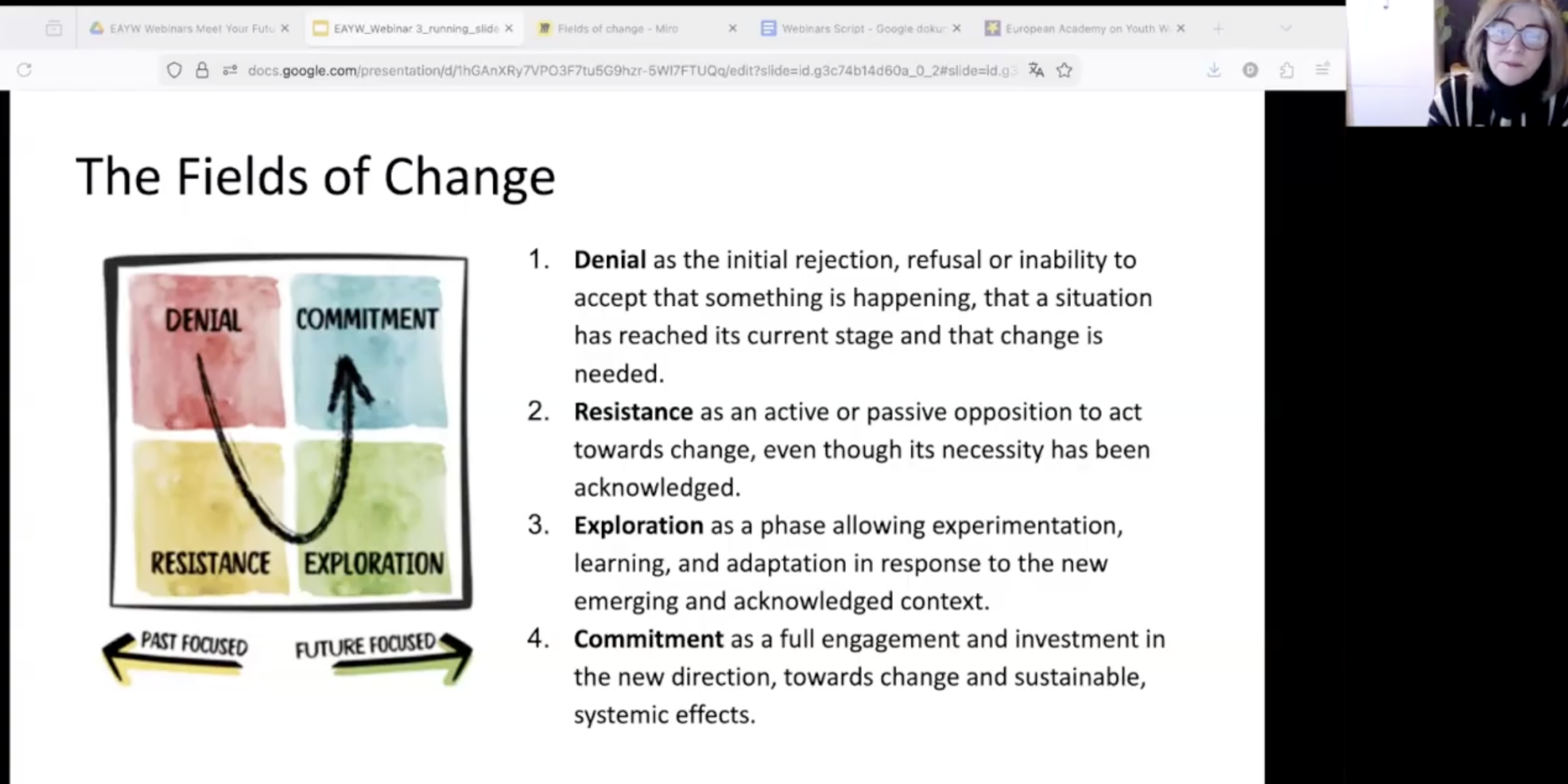
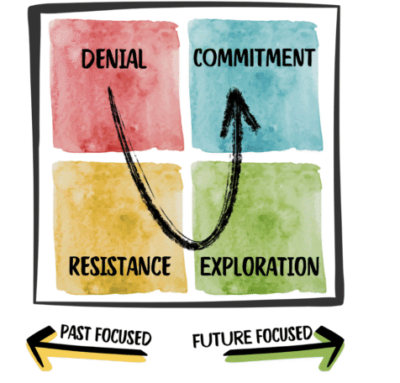 After this introduction, the first tool, Fields of Change was introduced – it helps youth workers to map their responses to change across four positions: denial, resistance, exploration and commitment. The movement begins in denial, where change is ignored, rejected or simply felt to be too difficult to face. From there, it can shift into resistance: a stage where people recognise that something is happening, but are still reluctant or unable to act. Exploration is the point where learning, experimentation and adaptation begin. Commitment, the final position, reflects a more strategic response: when a person, team or organisation has fully invested in a new direction.
Rather than treating change as a single moment, the model frames it as a process. It also puts attention to the “liminal” space between resistance and exploration: the uncomfortable but often productive stage where something begins to move.
To test the tool in practice, participants worked in small groups to identify one to three major challenges affecting their work, and then placed their responses within the quadrants. The issues they discussed ranged from AI and digital overload to youth mental health, instability and participation. When talking about the exercise, participants said that some responses remained in resistance while others had moved into exploration. A few responses were already approaching commitment, and surprisingly, some challenges were placed in denial. It was noted that the same issue could be experienced very differently depending on context, experience and perspective. For example, AI can appear across several quadrants at once – from uncertainty and hesitation to active experimentation.
Change is not only external
In the previous exercise, participants focused mostly on the level of youth work and organisations. Then, however, the webinar focused more on internal change. The second exercise, How Do I Relate to Future Changes? invited participants to look at their own internal reactions when facing change. Before labelling a situation as denial, resistance or exploration, the tool asks a more personal question: Where do I stand internally?
This shift in focus added another layer to the discussion. It suggested that responding to change is not only about strategies and systems, but also about emotions, hesitation, readiness and the beliefs people hold about their own ability to adapt. In that sense, the webinar made clear that change in youth work is both structural and personal. The way people feel, interpret and position themselves matters just as much as the external pressure itself.
Learning to recognise change
At the end of the webinar, it was mentioned that the purpose of the tools is to support reflection, conversation and exchange within teams, organisations and youth work settings. They are meant to help people make sense of what is changing, where they currently stand and what might help them move forward.
And yes, we do not need to have all the answers. Learning to recognise change and being honest about how we respond to it are important steps in becoming more future-ready.
If you are interested in checking the tools that were presented within this webinar series, you can explore and download the resources from our Futures Toolbox.
If you would like to watch the recording from our webinar, you can watch the video down below.