

What does the future mean to youth workers and for young people? What does it mean to prepare for the future when the world already feels like it is changing faster than we can keep up? These were the central questions in the second webinar from the “Meet your future – Tools to navigate the future of youth work” series, which brought participants together to explore how youth work can better respond to uncertainty, disruption and change.
Instead of trying to predict what comes next, the webinar focused on something more practical: how to strengthen the ability to notice signals, imagine possibilities and make more informed choices in the present. At a time when youth work is being shaped by different factors, from digital transformation to political instability and mental health concerns, this kind of future-oriented thinking is becoming an essential skill. And during the two hours, participants had the chance to explore two tools from the Futures Toolbox: Three Horizons and Window to the Future.
Moving beyond reaction
The webinar opened with a simple question: what is the first thing that comes to mind when you hear the word future? The answers ranged from hope and opportunity to fear and uncertainty. For many youth workers, the word future is directly connected with the challenges young people are facing today.
That is where futures thinking comes in. As presented during the webinar, it is less about forecasting and more about building readiness: creating space to reflect on change, recognise patterns early and think more deliberately about where current developments might lead.
 The first tool introduced during the session was Three Horizons, a method that helps to explore change across different timeframes. The first horizon focuses on the present and the systems already in place. In youth work, this means looking at the methods, structures and assumptions that are shaping practice today. The second horizon turns to disruption: the developments that are already beginning to challenge our ways of working. Artificial intelligence featured strongly in this part of the discussion, as participants reflected on the growing influence of new technologies on communication, learning and project development. The third horizon looks further ahead. It asks participants to notice weaker, quieter signals and think about what youth work might look like if those developments continue to grow. The idea is not to predict one fixed future, but to widen the conversation beyond what feels immediate and familiar.
Using the topic of supporting youth participation, participants worked in groups to test the framework in practice. Their discussions highlighted both the value and the difficulty of future thinking: It is often easy to describe the present, but much harder to imagine what lies beyond it. Also, participants concluded that it is important to notice less visible changes that are happening more quietly, and not focus only on major shifts that everyone is talking about.
A more playful way into the future
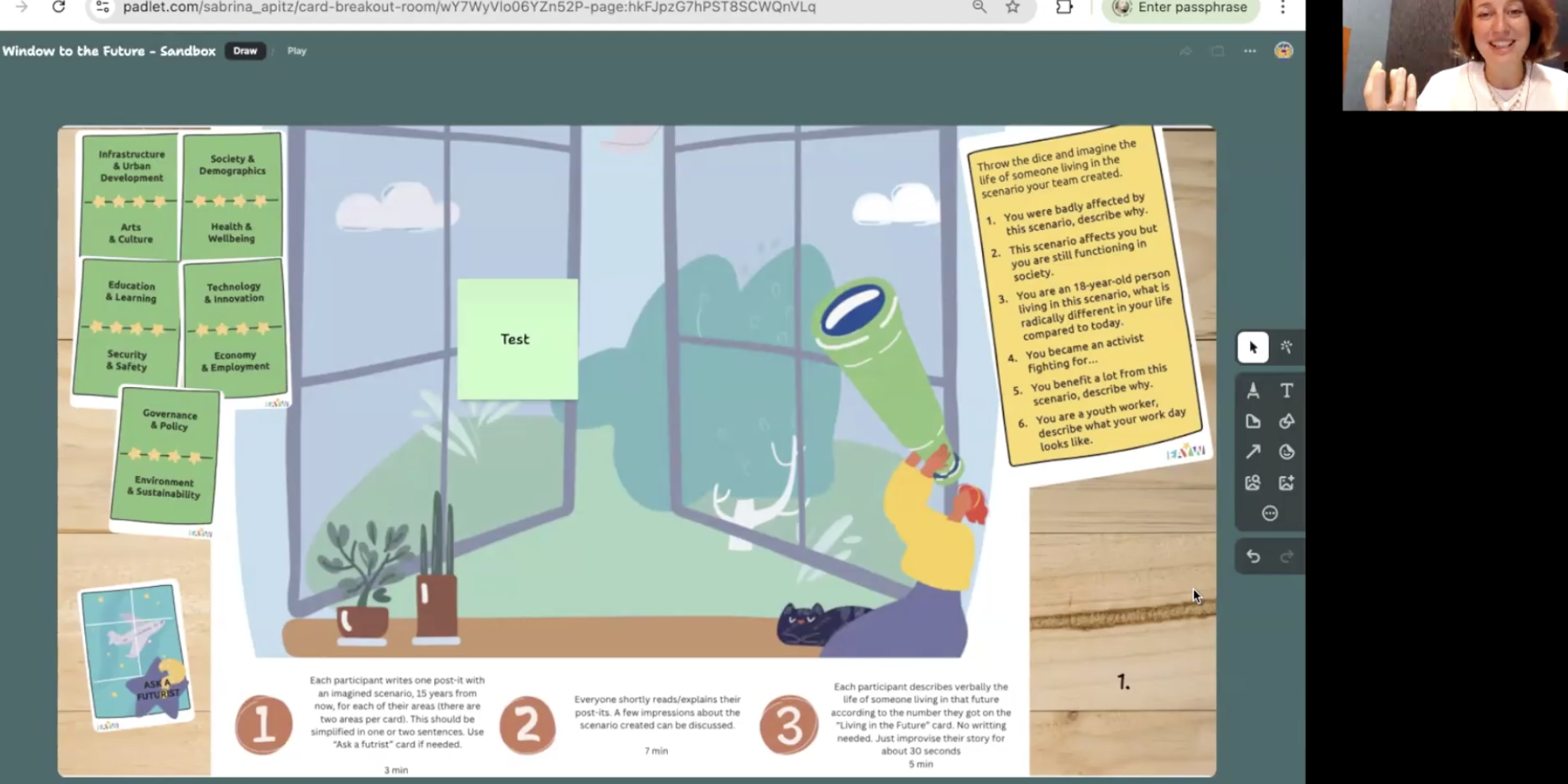
The second tool introduced in this webinar, Window to the Future, took a more playful approach. Designed as a game, it invites participants to imagine possible futures by starting with signals they can already see around them and building outward from there. Using themed cards linked to areas such as education, health, safety and employment, players develop future scenarios and then consider what life inside those futures might actually feel like – participants were encouraged to imagine the everyday experiences of people living in those possible futures. By doing the last part of imagining, the exercise brings empathy and storytelling into the whole process. Participants were happy with the game and shared that the point for them is not to predict the future, but to be prepared for uncertainty and be more aware of the changes ahead and how to respond to them.
Instead of a conclusion…
In a fast-changing environment, the challenge is not just to keep up with everything happening around us, but to keep asking better questions about what is emerging, what matters and what kind of future we want to help create. And this is what youth work needs to put emphasis on.
If you are interested in checking the tools that are presented within the webinar series, you can explore and download the resources from our Futures Toolbox.
If you would like to watch the recording from our webinar, you can watch the video down below.